
To understand why a damp crawlspace compromises your living zones, you must look at a building dynamic known as the stack effect. Your home acts exactly like a giant chimney. As warm air naturally rises and escapes through your upper-level windows, ceiling fixtures, and attic insulation, it creates a powerful vacuum on the lower levels of the house.
This thermal vacuum pulls replacement air upward through your floorboards and utility penetrations. In fact, environmental scientists estimate that up to fifty percent of the air you breathe on your first floor originated in your crawlspace. If that space is filled with raw dirt, pooling water, or thriving mold colonies, the stack effect continuously distributes those damp, mold-spore-laden air masses directly into your main living environments, altering your indoor air quality and triggering chronic musty house smells.
The old philosophy behind open crawlspace vents was simple: let exterior air circulate to dry out the space. Unfortunately, this design backfires completely during humid summer months. When hot, moisture-saturated summer air flows through an open vent into a dark crawlspace, it collides with concrete foundation walls and wood framing that are naturally cooled by the surrounding earth.
When warm, humid air hits a cold surface, it reaches its dew point instantly, causing massive amounts of water vapor to condense into active liquid droplets across your structural wood and insulation. This turns your crawlspace into an accidental greenhouse. Conversely, in the winter, those same open vents invite freezing air inside, chilling your under-floor plumbing pipes and cooling your floors, forcing your heating systems to work twice as hard to maintain comfortable temperatures.
Leaving a crawlspace exposed to high humidity levels eventually leads to severe structural failure. Wood is a porous organic material, and when its moisture content remains elevated, it creates the perfect breeding ground for wood-destroying fungi. Over time, fungal rot quietly breaks down the cellular fiber integrity of your load-bearing sub-floor joists and main sill plates.
As the wood framing weakens, it yields under the heavy weight of the home above. Homeowners typically notice this as sagging or bouncing floorboards, unlevel transitions between rooms, or new gaps appearing between the baseboards and the floor. Furthermore, excessive moisture softens the raw interior support soils, causing the concrete pads or columns supporting your internal floor jacks to sink, throwing your home’s entire framing alignment out of balance.
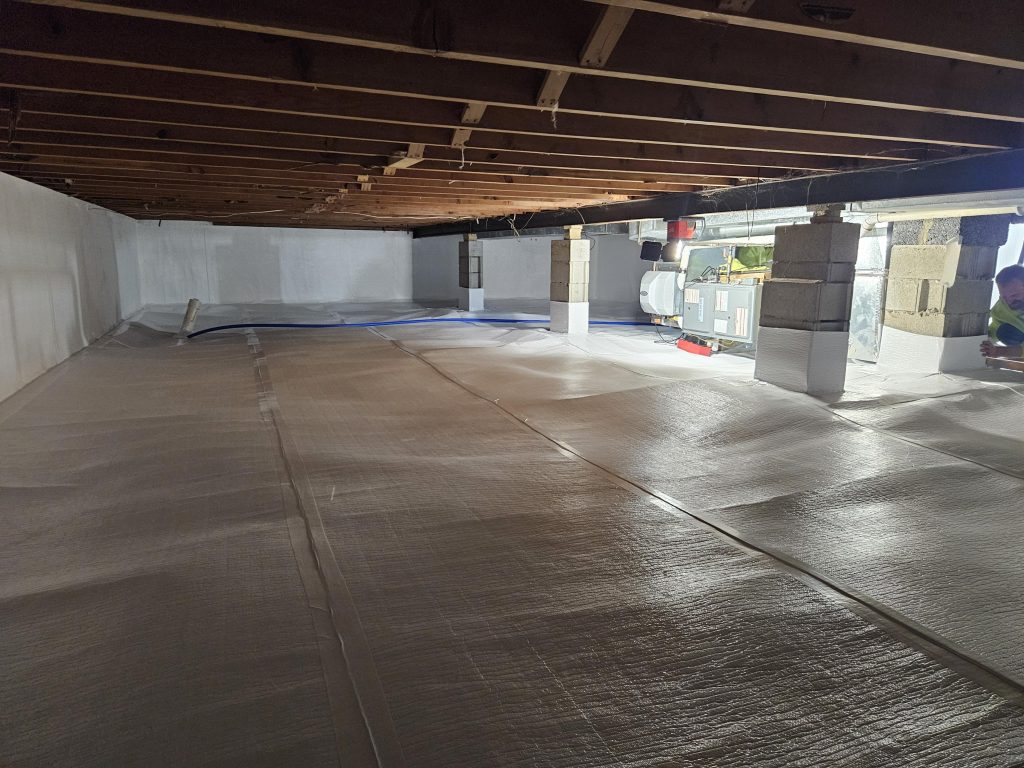
Resolving crawlspace dampness requires complete system isolation. Professional crawlspace encapsulation completely re-engineers the space into a clean, dry, conditioned environment through a structured mechanical process:
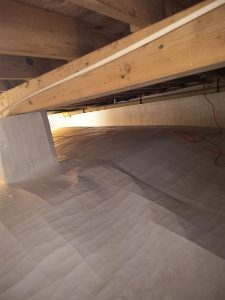
Yes, absolutely. By completely isolating the raw dirt floor and damp concrete walls behind a heavy-duty vapor barrier and maintaining dry conditions with a dehumidifier, you eliminate the moist environment where mold and mildew thrive, permanently stopping foul odors from rising into your living zones.
In many cases, yes. If the moisture crisis is caught before structural wood rot completely destroys the fiber integrity, sagging floor joists can be reinforced by a process called sistering—where new structural lumber is bolted directly alongside the weakened joist—and re-supported using heavy-duty adjustable steel crawlspace jacks.
Modern building codes fully recognize closed, conditioned crawlspaces as superior to traditional vented ones. However, the code dictates that if you close the vents, you must install a continuous, code-compliant vapor barrier and provide a permanent mechanism for air conditioning or mechanical dehumidification.

Tom Trinko is the dedicated owner of Basement Repair Specialists, a company renowned for its expert solutions in basement and foundation repairs. With a strong commitment to excellence and customer satisfaction, Tom has led his team to become one of the leading providers in the industry. Under his guidance, Basement Repair Specialists have developed a reputation for their reliability, innovative repair techniques, and exceptional service. Tom’s leadership is defined by his vast industry knowledge, customer-first approach, and a steadfast dedication to providing homeowners with cost-effective, durable solutions for their basement and foundation needs. For more information about Tom Trinko and the services offered by Basement Repair Specialists, visit their website at https://basementrepairspecialists.com/.
Contact the Professionals at Basement Repair Specialists, LLC Today! (855) 554-7246