I thought long and hard about writing this article regarding our approach to water control in basements.
At Basement Repair Specialists, we use the term “water control” to describe our approach to reducing moisture problems in basements. We are not original in that regard. Many reputable contractors use water control to describe a repair designed to collect water from around or beneath foundation walls and direct it into a drain tile system. From there, the water is carried to daylight or, more commonly, removed by a sump pump.
But what is the difference between “water control” and “waterproofing”? In many cases, there is little practical difference between the repairs being described. The biggest difference is often how the contractor markets the repair and sets expectations with the homeowner.
“Waterproofing” is a popular term because it adds a sense of certainty to a repair. When properly designed and installed, a basement waterproofing system can eliminate or substantially reduce most common basement water problems.
However, neither waterproofing nor water control can guarantee that water will never enter a basement under every possible circumstance.
Consider a nearby river overflowing its banks and surrounding a home. Water may enter through basement windows, openings above the foundation wall, cracks or gaps along the sill plate. A sewer backup or plumbing failure may also introduce water regardless of the basement drainage system that has been installed.
These situations do not mean that a water-control system has failed. They mean that the source of the water falls outside the conditions the system was designed to manage.
The point is simple: some contractors offer certainty where absolute certainty may not be possible.
“Waterproof basement” promises and double-lifetime warranties may sound comforting, but homeowners should examine what those promises actually cover. What are you paying for when a warranty extends 50 years or more? Will the contractor still be operating under the same ownership? Does the warranty transfer to a future homeowner? What maintenance is required, and which types of water intrusion are excluded?
These are reasonable questions to ask before selecting a contractor.
As a company, Basement Repair Specialists stands behind its work. More importantly, we believe that a realistic explanation of the expected outcome is a more responsible and reliable approach than promising that a basement will remain completely waterproof under every imaginable condition.
A warranty should clearly identify the repair being covered and the conditions under which that coverage applies.
Before choosing a repair, it is important to understand how water and moisture can enter a basement. Common sources include:
Each source may require a different solution. This is why a proper inspection should identify both where the water appears and what is causing it to reach that location.
My friend—and our regional manager—Bob listened as I explained the topic I was considering for this article. He suggested including a resource from the University of Minnesota about water control in basements.
I had not previously read the article, but he was correct: it provides an excellent explanation of basement moisture sources and the different approaches available for managing them.
The updated resource, Moisture in Basements: Causes and Solutions, explains that basement moisture may originate from rain or groundwater, interior sources or humid exterior air. It also emphasizes identifying the source before selecting a repair.
Basement Repair Specialists normally installs what the University of Minnesota resource identifies as Approach 5: an interior drainage system beneath the slab.
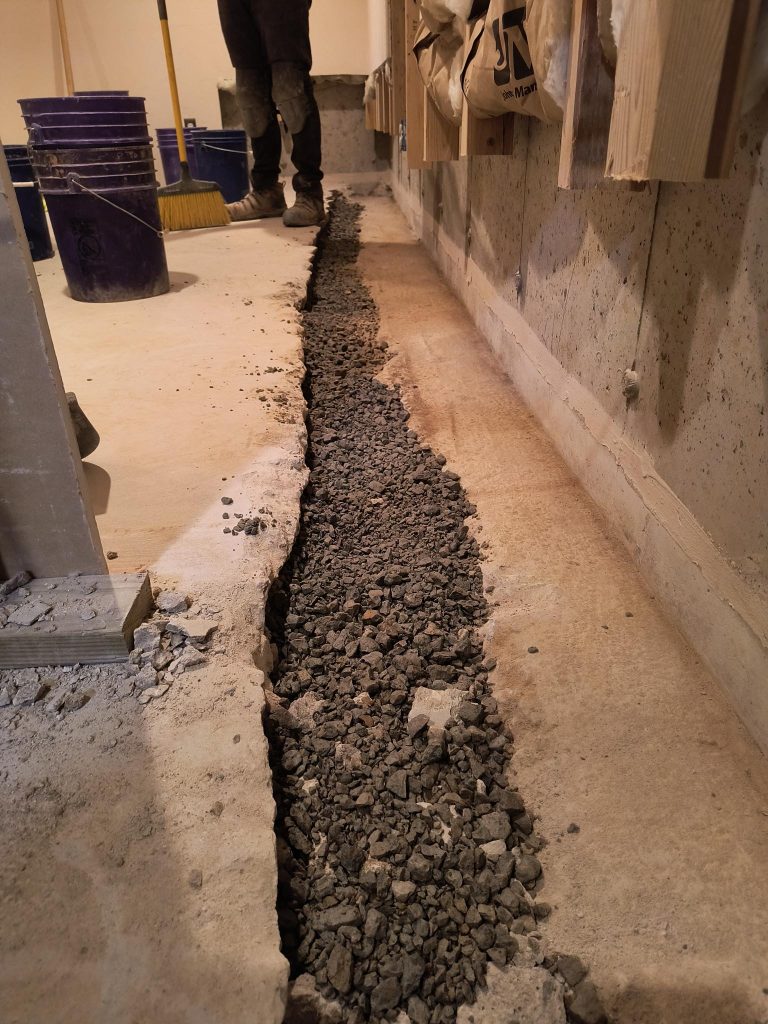
This approach generally involves removing a section of concrete around the interior perimeter of the basement, placing perforated drainage pipe below the slab and directing the collected water into a sump basin. A properly installed sump pump then moves the water to an exterior discharge point away from the foundation.
The system may also include a drainage membrane at the base of the wall to guide moisture into the drain tile.
Our interior drain tile systems are customized around the conditions of each property, including the foundation construction, water-entry points and expected water volume.
Approach 5 is generally the most comprehensive of the interior drainage options discussed in the University of Minnesota article. It is also one of the more costly ways to provide water control because it requires removing and replacing concrete and installing the drainage system below the floor.
Despite the more involved nature of the repair we install, our prices are often competitive with contractors offering systems that may not include all the components of this approach.
Drain tile collects and redirects water, but the sump pump must reliably remove it from the basement. The pump should be properly sized, correctly discharged and supported by a backup system when appropriate.
A complete water-control evaluation should consider:
Homeowners experiencing seepage or recurring basement moisture can learn more about our basement waterproofing and water-control services.
If you are fortunate enough not to be at the repair stage, pay close attention to the University of Minnesota’s advice regarding gutters, downspouts and grading.
Some basement water problems have relatively inexpensive solutions, but those solutions require homeowners to recognize the warning signs before water causes more substantial damage.
Keep gutters clear and in good condition. Extend downspouts far enough from the house to prevent roof runoff from collecting next to the foundation. Check that the soil slopes away from the home rather than directing water toward it.
These basic improvements can reduce the amount of water reaching the foundation. Once they have been neglected for an extended period—or when groundwater and drainage problems are already established—a more significant repair may be necessary.
The right approach begins with identifying where the water originates and how it is entering the basement. A contractor should explain what the proposed system will address, how it will move the water and what conditions fall outside the scope of the repair.
Basement Repair Specialists provides basement water-control evaluations and customized repairs for homeowners across Wisconsin, Minnesota and Northern Illinois.
If you are experiencing basement seepage, standing water or recurring moisture, contact Basement Repair Specialists for an evaluation. We will inspect the conditions, explain the available options and recommend an appropriate solution for your home.

Tom Trinko is the dedicated owner of Basement Repair Specialists, a company renowned for its expert solutions in basement and foundation repairs. With a strong commitment to excellence and customer satisfaction, Tom has led his team to become one of the leading providers in the industry. Under his guidance, Basement Repair Specialists have developed a reputation for their reliability, innovative repair techniques, and exceptional service. Tom’s leadership is defined by his vast industry knowledge, customer-first approach, and a steadfast dedication to providing homeowners with cost-effective, durable solutions for their basement and foundation needs. For more information about Tom Trinko and the services offered by Basement Repair Specialists, visit their website at https://basementrepairspecialists.com/.
Contact the Professionals at Basement Repair Specialists, LLC Today! (855) 554-7246